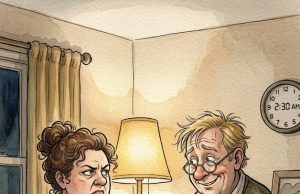
My husband placed the divorce papers on the table with a smile and said, “Accept my mistress, or we’re separating.” I signed the documents without hesitation. My husband went pale: “No, wait… you misunderstood…”
When Daniel Whitmore placed the divorce papers on the table, he did so with a smile I didn’t recognize. It was the same table where we had breakfast for twelve years, where we planned vacations and celebrated promotions. In a calm voice, he said, “Accept her as my mistress, or we’re separating.”
He didn’t look up; he seemed certain that I was going to beg, to negotiate, to cry. I did none of those things.
My name is Laura Bennett, I’m thirty-nine years old, and I’ve built my life with discipline. For months, I suspected inf:i:delity: dropped calls, “business” trips on Fridays, an unfamiliar fragrance on his shirts. Even so, I never imagined he would offer me a divorce as an ultimatum to normalize his affair. I looked at it, read every line of the document, and without hesitating, I signed. My pen didn’t tremble.
Daniel went pale. “No, wait, you misunderstood…” he stammered.
I got up, grabbed my bag, and told him we’d talk to the lawyers.
That night I didn’t sleep at home. I went to a nearby hotel and, from my bed, checked his emails: bank statements, contracts, old messages. Daniel had trusted his control too much.
The next morning I called Maria Collins, a lawyer who had been recommended to me. I told her everything precisely: dates, amounts, companies. We had signed a prenuptial agreement years before, but Daniel managed joint investments through a company where I was listed as a co-founder. He thought I would never check the books. He was wrong.
That same week, his “mistress,” Sophie Lang, appeared on our social media as a “consultant.” Too visible. Too fast. Daniel was rushing an ending he believed would be favorable. Meanwhile, I gathered evidence, kept copies, and requested internal audits. I wasn’t seeking rev:e:nge; I was seeking justice and clarity.
On Friday, Daniel called me ten times. I didn’t answer.
At eight o’clock that night, I received a message from his number: “We need to talk now. There’s something you don’t know.”
I took a deep breath, looked at the clock, and understood that the game had changed. What I had discovered that afternoon would make his smile disappear forever…
The following Monday, we met at Maria’s office. Daniel arrived late, his tie loose and his eyes sunken. He tried to regain control with rehearsed phrases: “It was a misunderstanding,” “Sophie is just a phase,” “I didn’t mean to hurt you.” Maria wouldn’t let him get away with it. She placed a preliminary audit report on the table: irregular transfers, personal expenses charged to the company, and a contract signed with Sophie using joint funds.
Daniel swallowed hard. “That can be explained,” he said. Maria replied calmly, “It will be explained to a judge if necessary.” I remained silent. My silence was my strength.
The strategy was clear: immediate division of assets, freezing of joint accounts, and a restraining order to protect my share. Daniel tried to negotiate privately, promising “compensation” and a quick divorce. I refused. Not because I wanted to prolong the process, but because the truth had to be set down.
Sophie, for her part, sent me an ambiguous message: “I didn’t want to cause any trouble.” I responded politely and firmly: there was nothing to discuss. The problem wasn’t her; it was Daniel’s decision and the consequences of his actions.
The following days were tense. Daniel lost a major contract when his company’s internal audit detected inconsistencies. I wasn’t the one who called anyone; the documents spoke for themselves. The reputation he had so carefully cultivated began to crumble. His smile was no longer present at meetings.
In a final attempt, Daniel asked to see me alone.
I agreed to meet at a neutral café. He arrived with rehearsed apologies and a higher financial offer. I listened to him, and when he finished, I said something simple: “I signed because you underestimated me. And because I deserve respect.” There were no shouts. No tears. Just facts.
That afternoon, we signed a provisional agreement that was favorable to me. It wasn’t an emotional victory; it was a realignment of reality. I returned to my temporary apartment with a new feeling: calm. The calm of knowing I had acted in time.
But the final closure hadn’t yet arrived. Two days later, Maria called me with news that would change the course of the case and, incidentally, Daniel’s professional future. What had come to light surpassed any marital ultimatum.
Maria’s call was direct: the external audit confirmed tax evasion linked to the company, with documents signed by Daniel. It wasn’t a minor accusation or a rumor; it was solid evidence. My name appeared as co-founder, but the irregular transactions were clearly authorized by him. Thanks to the protective measures, I was protected.
The process moved quickly. Daniel changed lawyers. His company opened an internal investigation. Sophie disappeared from the organizational chart and social media. I moved to a permanent apartment, resumed my routine, and, for the first time in years, felt that my life didn’t depend on maintaining someone else’s image.
The divorce was finalized months later with a fair settlement. I didn’t celebrate with champagne. I celebrated with a long walk and a quiet dinner. I learned that signing isn’t always surrendering; Sometimes it’s the first act of freedom. Daniel, on the other hand, had to face legal and professional consequences. I wasn’t happy about his downfall; I simply accepted that every decision has its outcome.
Over time, I began to share my story in spaces where others were seeking clarity.
Not to point fingers, but to remind everyone of something essential: read, ask questions, document. Love shouldn’t ask you to give up your dignity or your safety.
Today I look back without resentment. I know that if I had hesitated for even a second before signing, I would have lost the advantage. Information is power, and self-respect is non-negotiable. If I learned anything, it’s that no one has the right to impose conditions that negate you.
If this story made you reflect, tell us what you would have done. Would you have signed? Would you have confronted the situation differently? Share your opinion in the comments, and if you think it could help someone, share this story. Sometimes, a real-life experience can be the light someone else needs to make a timely decision.