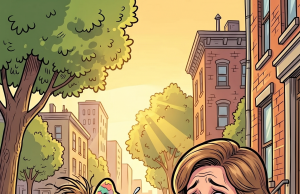
When Mia heard her father’s voice, time seemed to freeze.
The cafeteria went silent. Laughter di:ed mid-sound. Forks stopped clinking against trays. Every student turned toward the man standing in front of Mia—plainly dressed, yet carrying an intensity that filled the room.
Don Alfonso held the half-eaten, discarded burger in his hand. It trembled—not from fear, but from the effort of containing his anger.
“Dad…” Mia murmured, rising to her feet though her legs wobbled. “I’m fine, really—”
“No,” he said quietly but firmly. He dropped the dirty burger back onto the tray. “This is not fine. It will never be fine.”
His gaze swept across the room—past designer shoes and expensive watches, past untouched meals piled high, past teachers who suddenly found the walls fascinating.
“Who,” he asked, each word deliberate, “thought it was acceptable to hand my daughter someone else’s leftovers?”
Silence blanketed the room.
Then Stacy stepped forward, arms folded, wearing a tight, superior smile.
“Sir,” she said coolly, “this is just the cafeteria. If she can’t afford lunch, that’s hardly our problem.”
Don Alfonso approached her without raising his voice. He didn’t need to. His presence alone shifted the air.
“Your name?” he asked.
“Stacy,” she replied. “The mayor’s daughter.”
A ripple of whispers spread. It was clearly meant as a warning.
Don Alfonso gave a thin smile, one devoid of warmth.
“Ah,” he said. “That explains why you believe consequences don’t apply to you.”
The First Fracture
Within minutes, the principal hurried in, flanked by anxious staff members.
“Sir, this must be some misunderstanding—” he began.
“It is not a misunderstanding,” Don Alfonso interrupted calmly. “It is a pattern.”
He rested a steady hand on Mia’s shoulder. “Sit, my child.”
“Dad, I don’t want to make a scene—”
“The scene,” he replied, “has existed for years.”
He faced the principal. “How long has this gone on?”
The man had no answer.
“How many so-called scholarship students have you treated as second-class?”
Still silence.
He turned to the teachers. “How often did you witness this and pretend not to?”
One teacher lowered her eyes.
“And you,” he said to Stacy and her friends, “how many tears have you caused for entertainment?”
Stacy shifted uncomfortably. “We were joking.”
“A joke,” he said evenly, “ends before someone’s dignity is crushed.”
The Balance Shifts
By late afternoon, the story had spread across the school—and beyond.
People began whispering Don Alfonso’s name.
The discreet billionaire who owned one of the nation’s largest corporations.
The benefactor behind much of the school’s scholarship program.
The donor who funded the campus’s newest building.
And most importantly—
Mia’s father.
The next morning, attitudes changed overnight.
Parents who once boasted now measured their words. Students who mocked others suddenly avoided attention. Teachers who had been distant turned unusually attentive.
But Don Alfonso was not interested in temporary politeness.
The True Reckoning
He requested an assembly—students, parents, staff, and media present.
Before taking the stage, he made sure Mia and the other scholarship students were seated front and center—no longer in the shadows.
When he stepped up, he carried no prepared speech.
“I am not here to embarrass anyone,” he began.
A few relieved smiles appeared.
“I am here,” he continued, “to reveal the price of contempt.”
The auditorium grew still.
“We measure worth by wealth, status, and influence,” he said. “And when someone lacks those things, we assume they can be diminished.”
He paused.
“Money can vanish. Titles can collapse. Power is temporary.”
His gaze settled briefly on the mayor.
“But dignity,” he said firmly, “once destroyed, demands accountability.”
The Aftermath
Within a week, changes rippled through the school.
The principal was replaced.
Several staff members faced suspension.
The so-called “VIP tables” disappeared.
Complaints surfaced—far beyond Mia’s story. Voices that had long been silent were finally heard.
Stacy was summoned—this time with her father.
For once, her surname carried less weight.
Municipal projects supported by Don Alfonso’s company were quietly placed “under review.” No threats—just consequences.
New Voices
The cafeteria transformed.
Mia no longer sat alone. Students began mixing freely, though awkwardness lingered.
Some apologized. Others stayed distant. A few began to reflect honestly.
“I thought it was harmless,” one admitted.
“I didn’t want to be the next target,” said another.
Change was uneven—but real.
One afternoon, Don Alfonso found Mia laughing softly with friends over a simple meal.
“Dad,” she said gently, “I never told you because I didn’t want to rely on our money. I wanted to fit in.”
He smiled with understanding.
“Being wealthy is not wrong,” he said.
He met her eyes.
“Using wealth to belittle others—that is wrong.”
She hesitated. “Will they really change?”
He rose slowly.
“The world,” he said, “doesn’t transform because the powerful command it.”
He looked around the cafeteria, now filled with quieter conversations and braver eyes.
“It changes when those once silenced decide to lift their heads.”