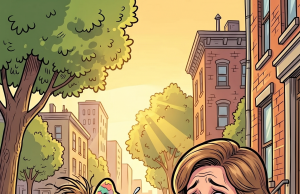
Madrid’s cold doesn’t just touch you—it moves in. It slips under your coat, climbs from the pavement, and settles into your knees like it owns the place.
For thirty years, I met that cold at five in the morning, right on schedule, pushing my food cart out of a narrow storage room and toward my corner in a brick-and-grit neighborhood where working people rise before daylight has the decency to show its face.
My name is Xiomara Reyes. You won’t find me in business books or celebrity headlines. My life is written in burns, oil splatters, and the stubborn smell of garlic that no soap fully erases. In my block, people know me as the rice lady. The stew lady. The one who feeds you when your stomach is empty and your pride won’t let you admit it.
That Tuesday was supposed to be ordinary. The sky hung low and muddy, heavy with the threat of rain. I stirred the saffron rice in my biggest pot, careful not to scorch the bottom—just toast it enough to make that crispy layer people love. While my wrist moved in steady circles, my mind counted worries: electric bills climbing again, my permit expiring soon, and my legs aching in ways they never did when I arrived from Mexico in my early twenties with one suitcase and a heart full of brave lies.
Then I heard a sound that didn’t belong to my street.
It wasn’t the groan of a bus or the thunder of a garbage truck. This was something smoother. Heavier. The soft purr of money.
I looked up and saw three Rolls-Royces slide into the loading zone like they owned the air. White, black, white—lined up with insulting elegance, blocking the curb as if the street itself was their private carpet.
In my neighborhood, one luxury car would cause people to lean out of windows. Three felt like a takeover.
I froze with the ladle raised mid-air. Steam blurred the edges of my vision, but I saw the doors open. Two men and a woman stepped out—young, polished, and dressed in the kind of clothing that doesn’t shout a brand name because it doesn’t need to. They moved toward me without hesitation, stepping over puddles as if dirt had never dared touch them.
And they were coming straight to my cart.
Fear moves fast. My first thought wasn’t curiosity—it was panic. Had someone complained? Was City Hall finally taking my license? Was this a health inspection looking for an excuse? I wiped my hands on my apron so hard I could feel the fabric bite.
They stopped at my counter. The scent of expensive cologne mixed with cumin and chicken. The man in the middle—navy suit, controlled posture—stared at me like he wasn’t seeing a street vendor at all.
His eyes were wet.
“You still make the rice the same way,” he said, voice cracking on the last word.
The street tilted.
That voice didn’t belong to a businessman. It belonged to a child who once shivered under the same Madrid sky.
My vision sharpened, as if time itself stepped closer. I noticed a faint scar above the eyebrow of the taller man on the left. I saw the guarded stance of the man in the center—defensive in a way money can’t polish away. I saw the woman’s wide, watery eyes, and something deep inside me unlocked.
The Rolls-Royces disappeared. The suits vanished.
In their place, I saw three thin children, filthy and shaking, huddled together on this very corner like sparrows trying not to die.
“Marco?” I whispered.
The man with the scar nodded, a single tear slipping down his beard like it had been waiting years to fall. “It’s me, Xiomara.”
My heart slammed once, hard. I turned to the man in the center. “Adrián?”
He smiled—crooked, familiar, painful. “The same one who promised I’d come back.”
Then my gaze went to the woman. Something in my brain stumbled, trying to match old memory to new shape.
“Nico?” I asked, half confused, half certain.
The woman lifted her chin with a quiet strength that stole my breath. “Now I’m Nicole,” she said. “But I’m still the one who hid behind your skirt.”
The ladle slipped from my fingers and clanged against the sidewalk. Nobody noticed. I stepped out from behind my cart, forgetting rules, forgetting hygiene, forgetting that I was an aging street cook and they were… whatever rich people become.
I opened my arms.
And the three of them rushed into me like children running from a storm.
We hugged under that ugly gray sky while neighbors gathered and phones came out. I felt their bodies—solid, grown, expensive—and I felt their sobs against my shoulder, the same way I once felt their ribs through thin coats.
And with that embrace, my mind fell backward through time.
Back to the beginning.
I came to Spain chasing the promise that Europe meant stability. In Mexico, food is love, but money disappears quickly. I arrived believing hunger would be less loud here.
I was wrong. Hunger speaks every language.
Those first years were hard enough to sand the softness out of anyone. I washed dishes in cafés where the boss watched soap like it was gold. I cleaned apartments for old women who inspected furniture like they were hunting for crimes. I slept in a shared room in Lavapiés, rotating bed time with other women like we were roommates with the night itself.
But I had one stubborn dream: I wanted to cook for a living. In my village, people used to joke that when I cooked, even the dogs stopped barking to smell it.
So I saved everything. I ate leftovers. I said no to comfort. And after wrestling Spanish paperwork like a monster with too many heads, I finally got a license and a secondhand cart. It wasn’t glamorous, but it was mine. I parked it on a corner near old buildings and an overgrown park and started selling.
Five plates the first day. Ten the next. Then more.
People began to realize my rice wasn’t just rice. It tasted like a home they missed.
That first winter—the one that made Madrid feel sharp and cruel—I saw them.
Three children, maybe ten or eleven, pressed against a brick wall near a closed bakery, trying to steal warmth from a vent. Their jackets were too small, their sneakers torn, mismatched socks showing. The dirt on them wasn’t from play. It was from living outside.
I was serving broth to a taxi driver when I felt their gaze. Six eyes fixed on my pot with a devotion only hunger can produce.
The neighborhood had warned me. Don’t feed them. People said all the usual ugly things—labels to make cruelty easier.
But when I looked at those kids, I didn’t see danger. I saw my little brother back home. I saw my own childhood.
When the taxi driver left, I moved quickly. I filled three bowls with hot chicken and rice and topped each with tortilla.
The tallest boy stiffened like he was ready to run. Later I’d learn his name was Marco. He put himself in front of the other two like a shield.
“We don’t have money,” he said, voice pretending to be tough.
I placed the bowls on the cold sidewalk between us. “It’s not for sale,” I lied gently. “Leftovers. I’d hate to waste them.”
There were no leftovers.
Marco stared like he expected a trick.
“What do you want?” the middle boy asked—Adrián, with the suspicion of an adult trapped in a child’s face.
“Eat while it’s hot,” I told them. “And bring the bowls back.”
I returned to my cart and pretended to clean, watching from the corner of my eye.
They approached like frightened birds. One, then the others. They ate fast, looking around like someone might steal food right out of their hands.
When they finished, the smallest—Nico back then—walked up and carefully placed the bowls on my counter.
“Thank you,” he whispered.
“My name is Xiomara,” I told him.
“I’m Nico. That’s Marco. That’s Adrián.”
And just like that, they entered my life.
They came back the next day. And the next. At first, we kept pretending there were “extras.” Eventually we stopped pretending. Every day at one o’clock, three bowls were waiting.
Their story arrived in pieces. Triplets. Mother gone. Father absent like he’d never existed. Foster care that separated them, crowded centers where older kids bullied them, stole from them, hit them. They ran away because being together mattered more than being “safe.”
“They try to split us,” Marco said one day, fists clenched. “They say there’s no room for three. They want us alone. I’d rather be on the street with my brothers.”
Winter worsened. On rainy days they stood soaked under awnings. I waved them closer beneath my umbrella and handed them hot chocolate.
“You can’t live like this,” I told them. “You’ll get sick.”
“We’re fine,” Adrián lied through chattering teeth.
That’s when I stopped being only the food lady. I became a quiet guardian. Old blankets. Dry socks. Secret signals when police were nearby—two taps of the ladle, and they vanished into alleyways like smoke.
People complained. Said I was attracting trouble. One afternoon a well-dressed man threatened to report me for feeding “those kids.”
Something hot rose in my chest.
“If hunger becomes a crime,” I told him, “come back and inform me. Until then, I run my side of the street. If poverty offends your nose, go eat somewhere with air-conditioning. Here, we serve humanity.”
He left furious.
Marco heard. His eyes widened like he’d never seen anyone stand up for them before.
“Nobody defends us,” he said.
“Well,” I snapped, because crying would’ve ruined me, “get used to it.”
But fear was real. And it came due one November morning.
A police patrol arrived with a social worker—not for the boys, but for me. An anonymous complaint. Unsanitary stall. Obstruction. Encouraging begging.
The young officer asked for my papers. I handed them over, hands shaking, praying bureaucracy would show mercy for once.
“You’re missing a quarterly stamp,” he said, bored.
“I paid it,” I insisted, digging for receipts.
“Not on record. We’re impounding the cart until it’s resolved.”
My blood turned to ice.
They called a tow truck.
I stood in front of my cart like a fool, begging and crying, alone against uniforms and paperwork.
Then the boys appeared.
Not hiding. Not running.
They sprinted toward me and stood between me and the officers, three skinny bodies forming a wall.
“Leave her alone!” Marco shouted.
“She didn’t do anything!” Nico cried.
Adrián shoved forward a crumpled paper—my receipt. He’d saved it when I dropped it. He’d written down my payments like it mattered because I mattered.
“Here!” he snapped. “It’s paid!”
The officer checked, sighed, and waved the tow truck away.
When they left, I turned on the boys, shaking with rage and relief. “You could’ve been taken!”
Marco’s face was solemn. “You feed us,” he said. “We watch you. We’re a team.”
That was the day I realized I wasn’t alone in Spain anymore.
I had a family—broken, stitched together, but real.
With help from a public defender named Elena, we fought the system. Paperwork, meetings, more waiting than any person deserves. Eventually we got them into a supervised program that kept them together. They had a roof, school, a chance.
But every weekend they returned to my cart. They grew taller. Stronger. Louder. Marco became protective muscle. Adrián studied like his life depended on it, obsessed with laws. Nico—Nicole—showed a sharp gift for numbers and detail, and a quiet eye for beauty.
I aged in the meantime. Gray hair. A hernia surgery. Knees that screamed after long hours. But when they showed up with report cards and stories and problems, I felt young again.
“Study,” I told Marco, sliding him extra food. “Study so you don’t end up freezing like me.”
“One day,” he swore, “I’ll get you out of here. I’ll buy you a restaurant.”
I laughed. “Yes, and I’ll be the Queen of England. Eat.”
University took them away—Barcelona, Valencia, then farther. On their last day, they promised they’d visit, promised they’d call, promised they’d never forget.
At first, they did call. Then less. Then rarely.
I didn’t blame them. Life moves. Painful pasts get buried. Maybe remembering me meant remembering hunger.
The neighborhood changed too. New cafés with ridiculous prices. Old neighbors pushed out. My cart looked older every year—like a stubborn relic refusing to disappear.
Then City Hall sent the letter: no renewal due to “aesthetic regulations.” They wanted modern, uniform stalls for the new pedestrian street. I couldn’t afford modern. That meant I was done.
That Tuesday—the day the Rolls-Royces came—was one of my last days. I was stirring rice like I was stirring goodbye, wondering where an old woman with no pension and no family goes when the only place she belongs is taken away.
And then the present cracked open.
The three of them stepped back from our hug and looked at me, eyes shining like they’d carried this moment for years.
“What are you doing here?” I demanded, wiping tears with my apron. “And those cars—did you rob a bank?”
Adrián laughed, bright and clean. “No, Xiomara. We built something.”
“We started a company,” Nicole said, gripping my hands. “Fintech. We started small—like those movie stories—but with the rage of people who know what it’s like to have nothing. Marco runs operations, Adrián handles legal, I run finance.”
“And we did well,” Marco added quietly. “Very well.”
I stared at the cars. “That’s… more than well.”
“We had a reason,” Marco said. “We had a debt.”
“You don’t owe me anything,” I shot back. “I fed you because I loved you.”
“We know,” he said. “That’s why it’s an honor debt.”
Adrián motioned, and one of the drivers approached with a leather folder.
“We heard about City Hall,” Adrián said. “We heard they were trying to remove you.”
My chin dropped despite my pride. Shame is a reflex when you’ve been poor too long.
Adrián’s voice hardened. “You’re not an eyesore. You’re the heart of this street.”
He handed me the folder. “Open it.”
My hands trembled as I untied the ribbon. Inside were notarized documents, stamps, architectural plans.
I didn’t understand most of the legal language. Then Nicole pointed behind me—at the old building on the corner, the abandoned bank with huge windows.
“Read the owner line,” she whispered.
I read it once. Twice.
Owner: Xiomara Reyes.
My knees nearly gave out.
“We bought it,” Marco said. “Ground floor for your restaurant. First floor for your home. No more subway at five a.m.”
“Bought?” I croaked. “That costs—”
“It’s yours,” Nicole said firmly. “Your restaurant. Xiomara’s Corner. Permits are approved. Renovation starts Monday.”
I tried to protest, tried to say I couldn’t accept, tried to find a way to refuse something that big without insulting them.
Adrián shook his head. “You paid thirty years ago. Every bowl of rice. Every blanket. Every time you stood between us and the world. This is not charity. It’s interest.”
And then I cried—not politely, not quietly. I cried like a person finally exhaling after decades of holding her breath.
Marco held me upright. “You don’t fight alone anymore,” he whispered. “Not ever.”
Nicole pulled out another set of papers—design sketches. At the entrance, drawn with care, was my old metal cart restored and shining.
“The cart stays inside,” she said. “Because this started there.”
“And we’re starting the Three Bowls Foundation,” Marco added. “Every day at one o’clock, we open a back section—free meals for any child or family in need. No questions.”
I laughed through tears. “I’m going to kick you out if you don’t eat.”
People around us clapped. Some neighbors cried openly. Even a police officer who’d wandered over for the illegal parking looked at the scene and quietly decided to see nothing.
We began serving like old times—except now the “kids” wore suits worth more than my cart. Marco called out “Hot rice!” like he used to. Adrián handed out napkins. Nicole wiped sauce off the counter with the fierce pride of someone returning to the place that raised her.
The pot emptied fast. Word spread: Xiomara’s kids are back. And they came back like royalty.
At two-thirty, the past tried to bite again.
A City Hall patrol car rolled up with a tow truck behind it. Inspector García stepped out holding a red folder, the kind of man who enjoys small power over small people.
He stopped when he saw the Rolls-Royces. Then he saw me and regained his smug calm.
“Mrs. Reyes,” he said, ignoring the three elegant adults beside me, “you were notified this is your last day. You’re still operating. We’ll remove your stall and issue a fine.”
My stomach knotted the way it always used to.
But before I could beg out of habit, Adrián’s hand settled on my shoulder—steady.
He stepped forward, buttoned his jacket, and walked to the inspector like a man who has argued with judges and won.
“Good afternoon,” Adrián said pleasantly. “Is there a problem with my client’s property?”
García narrowed his eyes. “This is a public street. And she doesn’t have a valid license.”
Adrián smiled and produced documents. “Renewed this morning. Paid five years in advance. Registry stamp included.”
The inspector blinked.
“And the vehicles,” Adrián continued, “have a special permit for a charity filming event authorized by the cultural department. We’re inaugurating the Three Bowls Foundation. If you seize anything, you’ll be disrupting a public charity and a community heritage event.”
He leaned in slightly, voice still polite. “My firm enjoys litigating administrative abuse of power. I have time. I also have an impressive amount of resentment.”
García glanced at the papers, the phones recording, the Rolls-Royces, the crowd.
His arrogance collapsed into paperwork fatigue.
“Everything’s in order,” he muttered. “Have a… good day.”
He signaled the tow truck away.
The neighborhood erupted.

Adrián winked at me. “I told you I’d study so nobody could cheat you again.”
“You little criminal,” I said, laughing and crying at once. “But you’re my favorite.”
By sunset, they led me into the building I’d watched decay for years. Keys clicked. A heavy oak door opened. An elevator that actually worked carried us up.
The apartment wasn’t cold luxury. It was warm. Cream walls. Wooden floors. Plush furniture. Heat that felt like mercy.
I walked slowly, touching things like they might vanish. Then I pulled back the curtain and looked down at my corner—my whole life—now seen from safety.
“It has three bedrooms,” Nicole said. “One for you. One for guests. And one… well, in case your ‘grandchildren’ visit.”
“Grandchildren?” I repeated, stunned.
Marco scratched the back of his neck, suddenly shy. “My wife is pregnant. Five months.”
I screamed and hugged him like he was twelve again.
Adrián lifted his hands. “Not me. I’m married to work. But I’ll spoil Marco’s kid.”
That night they wouldn’t let me cook. They ordered fancy food, but we ate it at my kitchen table, telling stories until three a.m. For the first time in decades, I slept without an alarm set for four.
I slept ten hours straight.
The months that followed were chaos—dust, drills, decisions. They refused to make me a decorative mascot.
“It’s your kitchen,” they insisted. “You decide.”
I fought the architects. “I don’t want some glass-walled modern kitchen where everyone watches you sweat! I want walls!”
They gave me walls—and the best ovens, industrial stoves, floors that didn’t punish my knees.
They kept the exposed brick. Hung black-and-white photos of the neighborhood. But one wall remained empty until the day before opening.
Nicole smiled like she was holding a secret. A cloth covered the wall. Adrián pulled it away.
Framed behind glass was a yellowed sheet of notebook paper—stained, torn, precious.
I recognized the childish handwriting instantly.
Rules of the Reyes Siblings & Xiomara Survival Company.
A list followed—simple, fierce, sacred:
Never steal from the one who feeds you.
If there’s food, it is shared.
Xiomara is the boss.
Promise: repay every grain of rice.
Promise: never forget lemon chicken.
Final goal: keep Xiomara from getting cold.
My hand flew to my mouth.
“I wrote it the night you saved us from the police,” Adrián whispered. “I carried it in my wallet everywhere. Exams. Investor meetings. Lonely days. When I wanted to quit, I read the last rule.”
“You did it,” I breathed, touching the glass. “You really did it.”
On a small shelf beneath the frame sat three bowls—ceramic now, but shaped like memory.
Opening night wasn’t celebrity glamour, though important people showed up. It was a neighborhood celebration. Old customers. Retired workers. The taxi driver. Even some who’d once criticized me came smiling, pretending history hadn’t happened.
Nicole insisted I wear a spotless white chef uniform with my name in gold.
“Today,” she said, “you’re the queen.”
Service was beautifully chaotic. I tasted sauces, barked orders, adjusted salt, laughed until my ribs hurt. My “kids” didn’t cook—of course not—but they served wine, greeted guests, and made sure I never stood alone.
Near midnight, Marco tapped a glass for silence and climbed onto a chair.
“For many of you,” he said, “this was an old bank. For us, it was a cathedral. Thirty years ago, three children arrived at this corner believing the world was hostile. We were hungry—yes—but we were more afraid than hungry. Then a woman who had almost nothing shared what little she had.”
Adrián stepped in. “She didn’t ask for papers. She didn’t ask where we came from. She just saw cold children and warmed them. She taught us family is action.”
Nicole raised her glass, tears bright in her eyes. “This restaurant isn’t about profit. It’s about repayment—of love. And about making sure no one in this neighborhood has to believe the world is hostile again.”
The room shouted my name.
And me—the woman who had survived cold, police, loneliness—collapsed crying in the middle of my kitchen with happiness so sharp it hurt.
Two years have passed since that night.
The restaurant now has a waiting list for weekend dinners. Critics call my rice “poetry.” I laugh. It’s the same rice—only now it’s on prettier plates for the price it always deserved.
But my real pride arrives every day at one o’clock.
That’s when we close the front and open the back door—the one facing the alley. Families come who have had bad luck. New immigrants with the same lost look I once carried. Old people whose pensions don’t reach the end of the month.
We don’t feed them scraps.
We serve them the same meal we serve executives in the front. Hot rice. Stew. Fruit. Dignity.
My knees can’t handle endless standing anymore, so I train young cooks. Many come from foster homes. We give them jobs, teach them the craft, and enforce one sacred rule:
No one leaves here hungry.
Marco, Adrián, and Nicole come every Sunday. Marco brings his little boy—Leo—who already steals ham when he thinks I’m not looking. Adrián still claims he’s married to work, but the foundation has expanded into other neighborhoods. Nicole keeps the numbers steady, proving generosity can be sustainable.
Sometimes, after closing, I step outside alone and stand on my old corner.
Madrid’s cold is still the same—dry, sharp, stubborn.
But I don’t shiver anymore.
I look through the restaurant window at warm light, at the framed photo of three children eating on the sidewalk, at the gold plaque beneath it:
This is where it began. Where there is a plate of food, there is hope.
I think of the younger Xiomara—the frightened woman in a stained apron—and I want to hold her shoulders and say, Hold on. You don’t know what’s coming. Those three broken little birds will one day return with the wings you lost.
A black Rolls-Royce turns the corner, smooth as silk. The window glides down.
It’s Adrián, smiling.
“Need a ride home, boss?”
I glance at my corner one last time and smile.
“No,” I tell him. “I’m already home. But take me for a drive. Tonight I want to see Madrid from a heated seat.”
The engine hums. The city slides past. And I think—rarely, unbelievably—life can be fair.
But for life to be fair, someone has to start it.
Someone has to be brave first.
And there’s nothing braver than sharing your bread when you’re hungry too.